
Skip to Content

Debrief on IMF-World Bank 2023 Spring Meetings

Registrations Closed
Add to calendar:

Debrief on IMF-World Bank 2023 Spring Meetings

Description

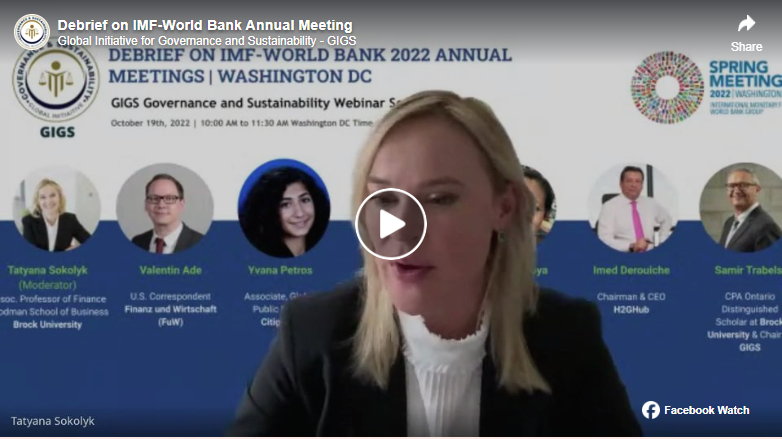
The debrief will look back on the highlights of the April 2023 IMF - World Bank Spring Meetings. We will explain the institutional background behind these meetings and share key takeaways of the IMF flagship reports, analytical corners and capacity building, and the outcome of the IMFC meetings.

Featuring leading policymakers, academics and practionners, the debrief will look back on the highlights of the April 2023 IMF - World Bank Spring Meetings.

We will explain the institutional background behind these meetings and share key takeaways of the IMF flagship reports, analytical corners and capacity building, and the outcome of the IMFC meeting.

The focus will be on the challenges facing the global economy as the IMF announced cuts to the global growth outlook. We will look at the risks posed by inflation to financial stability, and how countries can benefit from digitalization in a sustainable way.

We will conclude by discussing how countries can build upon these opportunities to undertake knowledge based reforms to mitigate the side effects of these extremely challenging external shocks .


Professional Development & Partnership Co-Design Day – NATCAP-HUB, October 9, 2026
NATCAP-HUB Valuation Hub Research Centre logo
NATCAP-HUB Valuation Hub Research Centre
Goodman School of Business, Brock University
Professional Development & Partnership Co-Design Day

From A Force of Nature to NATCAP-HUB

Building Canada’s Natural Capital Measurement, Valuation, Accounting and Finance Infrastructure

  • DateFriday, October 9, 2026
  • Time8:30 am – 5:15 pm
  • LocationRankin Family Pavilion (FRP) 214–215, Brock University
  • ConvenerDr. Samir Trabelsi, Principal Investigator
Strategic alignment with Canada’s Nature Strategy
Pillar 1
Protecting Nature in Canada
Measure outcomes
Pillar 2
Building Canada Well
Integrate nature into decisions
Pillar 3
Valuing Nature and Mobilizing Capital
Translate value into decisions and finance

Purpose of the day

This Professional Development Day is designed as a central co-design forum for the NATCAP-HUB SSHRC Partnership Grant resubmission.

Its starting point is A Force of Nature: Canada’s Strategy to Protect Nature, which establishes a national vision in which Canada protects, restores, and values nature as a foundation of the economy, sovereignty, well-being, resilient communities, and long-term prosperity.

The strategy makes clear that achieving Canada’s nature ambitions requires partnerships among Indigenous Peoples, governments, investors, businesses, philanthropies, communities, and other stakeholders. This provides a strong policy foundation for the NATCAP-HUB Partnership Grant.

How can NATCAP-HUB provide the research, measurement, valuation, accounting, governance, AI, and finance infrastructure required to translate Canada’s nature ambitions into credible organizational, investment, and public-policy decisions?

Across the three pillars, NATCAP-HUB will focus on the critical research chain
  1. Nature
  2. Measurement
  3. Valuation
  4. Accounting
  5. Disclosure
  6. Decisions
  7. Capital
  8. Measurable Nature Outcomes

Objectives

  1. Strengthen the intellectual architecture of the NATCAP-HUB SSHRC Partnership Grant.
  2. Map the NATCAP-HUB research program directly onto the three pillars of A Force of Nature.
  3. Identify priority indicators, datasets, valuation approaches, accounting frameworks, AI applications, pilot sites, and financing mechanisms.
  4. Strengthen Indigenous participation, data governance, and plural approaches to valuation.
  5. Clarify the roles and contributions of academic and non-academic partners.
  6. Identify concrete Canadian implementation and demonstration opportunities.
  7. Develop actionable inputs for the SSHRC Stage 1 resubmission.
  8. Establish a 90-day Partnership Grant work plan following the Professional Development Day.

Schedule at a glance

Select a session to read its full description.

  1. 8:30 – 9:00 amRegistration and coffee
  2. 9:00 – 9:15 amWelcome, Land Acknowledgement and NATCAP-HUB/SSHRC PG objectives
  3. 9:15 – 10:00 amKeynoteFrom A Force of Nature to NATCAP-HUB: Building Canada’s Natural Capital Decision Infrastructure
  4. 10:00 – 10:30 amBreak
  5. 10:30 – 11:30 amPanel 1Protecting Nature: From Measurement Gaps to Decision-Grade Indicators
  6. 11:30 am – 12:30 pmWorking LunchNATCAP-HUB SSHRC Partnership Grant Co-Design Lab
  7. 12:30 – 1:30 pmPanel 2Indigenous Leadership, Plural Valuation and Governed Conservation
  8. 1:30 – 1:45 pmBreak
  9. 1:45 – 2:45 pmPanel 3Building Canada Well: Mapping, AI, Natural Capital Accounting and Disclosure
  10. 2:45 – 3:00 pmBreak
  11. 3:00 – 4:00 pmPanel 4Valuing Nature and Mobilizing Capital
  12. 4:00 – 4:15 pmClosing SynthesisFrom the Strategy to the SSHRC Partnership Grant
  13. 4:15 – 5:15 pmReception and Partnership Networking

Sessions

Keynote9:15 – 10:00 am

From A Force of Nature to NATCAP-HUB: Building Canada’s Natural Capital Decision Infrastructure

Duration
45 minutes · 30-minute address and 15-minute moderated Q&A
Chair
Dr. Samir Trabelsi

The keynote will establish the policy and intellectual foundation for the day.

Canada’s strategy recognizes that nature supports economic prosperity, jobs, food security, resilience, and long-term competitiveness. It also identifies a need to accelerate action across governments, businesses, Indigenous Peoples, and other partners.

The keynote will position NATCAP-HUB as a potential research and decision infrastructure connecting the three federal pillars rather than as a collection of separate research studies.

Particular attention will be paid to Pillar 3. The strategy states that public funding alone cannot close the nature-finance gap and calls for public and private capital, innovative financing models, improved natural-capital accounting, and better integration of nature’s value into decision-making.

Discussion questions 5
  • What does Canada need to move from protecting nature to measuring and demonstrating nature outcomes?
  • How can ecological evidence be translated into accounting, corporate, investment, and policy decisions?
  • Where are the major measurement, valuation, accounting, and financing gaps?
  • What distinctive contribution can NATCAP-HUB make through a seven-year SSHRC Partnership Grant?
  • How can the NATCAP-HUB research architecture generate evidence relevant to the Expert Taskforce on Natural Capital Accounting and Nature Financing?
SSHRC PG deliverable
Canada Nature Strategy–NATCAP-HUB Alignment Framework

A one-page framework linking the three federal pillars to NATCAP-HUB research themes, partners, methodologies, pilots, HQP development, and expected impacts.

Panel 1Pillar 110:30 – 11:30 am

Protecting Nature: From Measurement Gaps to Decision-Grade Indicators

Duration
60 minutes
Chair
Ramsha Ahmad, KPMG
Panelists
Dan White, Altaf Arain, Bailey Church, Shahryar Rahman

This panel provides the empirical foundation of the NATCAP-HUB Partnership Grant.

Canada aims to protect 30% of its lands and waters by 2030 and proposes a combination of protected areas, Project Finance for Permanence initiatives, Other Effective Area-Based Conservation Measures, Indigenous Protected and Conserved Areas, and other partnership-based approaches.

But achievement of numerical targets alone does not answer the critical research question: are organizations, investments, and conservation interventions producing measurable improvements in biodiversity and ecosystem condition?

The panel will examine the data infrastructure required to connect corporate and facility activity with biodiversity outcomes, including facility locations, protected and conserved areas, Key Biodiversity Areas, ecosystem condition, pollution, land use, and other geospatial information.

Discussion questions 7
  • Which combinations of ecological, facility, protected-area, and geospatial data can support decision-grade natural-capital indicators?
  • What does a credible biodiversity baseline look like?
  • How should NATCAP-HUB distinguish area protected from ecological outcome achieved?
  • How can indicators capture changes in ecosystem condition and ecosystem services?
  • Where are Canada’s most significant measurement and data gaps?
  • How should indicators be validated before they are used in accounting, corporate disclosure, investment, or public policy?
  • What Canadian pilot settings should be embedded in the SSHRC Partnership Grant?
SSHRC PG deliverable
NATCAP-HUB Measurement and Indicator Architecture

The panel will identify priority indicators, datasets, validation methods, data gaps, and potential Canadian pilot environments.

Working Lunch11:30 am – 12:30 pm

NATCAP-HUB SSHRC Partnership Grant Co-Design Lab

Duration
60 minutes
Facilitator
Dr. Samir Trabelsi

The working lunch will turn the policy and research discussions into an integrated SSHRC Partnership Grant architecture.

Participants will work in interdisciplinary groups around: Research Question → Data → Method → Partner → Pilot → HQP → Output → Impact. Each table will explicitly connect its work to one or more pillars of A Force of Nature.

Particular attention will be given to the federal strategy’s emphasis on partnerships and to the SSHRC Partnership Grant requirements for co-creation, interdisciplinary integration, partner engagement, HQP development, knowledge mobilization, and long-term impact.

Working-lunch outputs

  • Refined NATCAP-HUB theory of change
  • Research-theme interdependencies
  • Partner responsibility matrix
  • Priority Canadian pilots
  • HQP training opportunities
  • Knowledge-mobilization opportunities
  • Missing expertise and potential new partners
  • Specific revisions required for the SSHRC Stage 1 application
Panel 2Cross-cutting12:30 – 1:30 pm

Indigenous Leadership, Plural Valuation and Governed Conservation

Duration
60 minutes
Chair
Jonathan Parenteau
Panelists
Jonathan Parenteau, Russell Evans

Indigenous leadership should be treated as a cross-cutting foundation of NATCAP-HUB, rather than simply as one research variable.

The federal strategy states explicitly that there is “no path to 30x30 without Indigenous leadership” and emphasizes Indigenous-led stewardship, Indigenous Guardians Programs, Indigenous Protected and Conserved Areas, and Project Finance for Permanence initiatives.

This session therefore examines how NATCAP-HUB can integrate Indigenous knowledge, plural values, stewardship, governance, and data sovereignty into the design of the Partnership Grant.

Discussion questions 6
  • How should instrumental, intrinsic, cultural, and relational values enter NATCAP-HUB valuation frameworks?
  • Which dimensions of nature should not be reduced to monetary values?
  • How can Indigenous knowledge and Western scientific approaches contribute without one subsuming the other?
  • At what stages should Indigenous partners participate in research governance, indicator design, valuation, pilots, interpretation, and knowledge mobilization?
  • How should OCAP®, CARE, and federated approaches inform NATCAP-HUB data governance?
  • What can NATCAP-HUB learn from Indigenous-led Project Finance for Permanence initiatives?

The federal strategy provides concrete PFP examples, including the Northwest Territories’ Our Land for the Future, which combines Indigenous leadership, government participation, philanthropy, conservation, and long-term financing.

SSHRC PG deliverable
Indigenous Partnership, Governance and Plural-Valuation Framework
Panel 3Pillar 21:45 – 2:45 pm

Building Canada Well: Mapping, AI, Natural Capital Accounting and Disclosure

Duration
60 minutes
Chair
Kareen Brown
Panelists
Anteneh Ayanso, Neila Ben Zina, Fayez Elayan, Olaf Weber, Peter Van Dijk

This panel directly connects NATCAP-HUB to Pillar 2, Building Canada Well.

The federal strategy proposes integrating Canada’s nature and economic agendas and specifically identifies mapping, data and artificial intelligence as tools for biodiversity identification, carbon accounting, project planning, permitting, and improved investment decisions. This creates a particularly strong policy connection with the NATCAP-HUB Partnership Grant’s proposed research on AI-enabled natural-capital valuation and decision support.

The session will examine how ecological evidence moves through: Mapping → Measurement → Valuation → Natural Capital Accounting → Corporate Disclosure → Assurance → Decision.

The discussion will consider frameworks including SEEA-EA, the Natural Capital Protocol, TNFD, GRI 101 and ESRS E4.

Discussion questions 7
  • How can mapping, remote sensing and AI strengthen natural-capital measurement?
  • Where can AI improve biodiversity identification, project assessment, permitting, and valuation?
  • What should AI not determine autonomously?
  • How can ecological indicators be translated into natural-capital accounts?
  • Which metrics belong in management systems and which belong in external reporting?
  • What audit trail is required before an AI-generated measure becomes decision-grade?
  • What role can assurance play in creating confidence in natural-capital information?

The federal strategy also proposes additional mapping of landscapes, including coastlines, peatlands and permafrost, to generate biodiversity and carbon-sequestration data that can support project investment decisions.

SSHRC PG deliverable
NATCAP-HUB Natural Capital Accounting, Mapping and Governed-AI Protocol
Panel 4Pillar 33:00 – 4:00 pm

Valuing Nature and Mobilizing Capital: From Natural Assets to Investment Decisions

Duration
60 minutes
Chair
Olaf Weber
Panelists
Anup Srivastava, Peter Easton, Amir Akbari, Jean-Philippe Levasseur

This session places Pillar 3, Valuing Nature and Mobilizing Capital, at the centre of the NATCAP-HUB Partnership Grant.

The strategy states that Canada’s natural assets underpin economic prosperity but that current investment is insufficient. It notes a global biodiversity-finance gap exceeding US$1 trillion annually and observes that more than 80% of existing biodiversity funding comes from public sources. The strategy concludes that public funds alone will not suffice.

How can credible measurement and valuation of natural capital change organizational decisions and mobilize capital toward nature-positive outcomes?

Discussion questions 9
  • What natural-capital information is sufficiently credible to influence investment decisions?
  • Which investor types respond to biodiversity risk, and through which decision mechanisms?
  • How does the credibility of natural-capital information affect capital allocation?
  • Can improved disclosure change corporate investment and operating behaviour?
  • How can researchers establish causality between better information and corporate change?
  • What role can blended finance and Project Finance for Permanence play?
  • What financial mechanisms can channel capital toward conservation and restoration?
  • How can public investment crowd in rather than substitute for private capital?
  • What evidence should NATCAP-HUB generate for Canada’s Expert Taskforce on Natural Capital Accounting and Nature Financing?

The Taskforce mandate described in the strategy directly overlaps with NATCAP-HUB’s research agenda: improving how nature is accounted for, integrating nature’s value into decisions, attracting private capital to conservation, and encouraging public-private partnerships.

SSHRC PG deliverable
NATCAP-HUB Nature Finance and Investor-Response Research Agenda
Closing Synthesis4:00 – 4:15 pm

From A Force of Nature to the SSHRC Partnership Grant

Duration
15 minutes
Convener
Dr. Samir Trabelsi

The closing session will move beyond a summary of the day’s discussion. Its purpose is to determine what the Professional Development Day changes in the Partnership Grant.

The synthesis will identify the strongest research questions emerging from the day, methodological changes required in the PG, key Canadian datasets, priority pilots, partner responsibilities, Indigenous governance requirements, AI and data-governance requirements, HQP opportunities, policy and practice pathways, potential contribution to the Expert Taskforce, and named leads and deadlines for the next 90 days.

  1. Canada’s Nature Priorities
  2. NATCAP-HUB Research Questions
  3. Measurement and Data
  4. Valuation
  5. Natural Capital Accounting
  6. Corporate and Public-Sector Decision-Making
  7. Investment and Finance
  8. Measurable Nature Outcomes
Reception4:15 – 5:15 pm

Building the Partnership

The reception will provide space for academic researchers, Indigenous partners, businesses, professional bodies, conservation organizations, government representatives, financial institutions and other partners to develop collaborations arising from the day’s discussions.

The goal is to move from conversation to partnership commitments, pilot opportunities and concrete contributions to the SSHRC PG resubmission.

Seven concrete outputs for the SSHRC PG resubmission

  1. Canada Nature Strategy–NATCAP-HUB Alignment Framework
  2. Revised NATCAP-HUB Theory of Change
  3. Measurement, Data and Natural Capital Indicator Framework
  4. Indigenous Partnership, Governance and Plural-Valuation Framework
  5. Natural Capital Accounting and Governed-AI Protocol
  6. Nature Finance and Investor-Response Research Agenda
  7. 90-Day SSHRC Partnership Grant Resubmission Action Plan

Together, these deliverables make the Professional Development Day itself evidence of co-creation, interdisciplinary integration, partner engagement and knowledge mobilization for the SSHRC Partnership Grant.

Preparing for the day

Pre-reading package

  • A Force of Nature: Canada’s Strategy to Protect Nature
  • Canada’s 2030 Nature Strategy
  • NATCAP-HUB SSHRC Partnership Grant concept document
  • SSHRC Stage 1 feedback
  • Preliminary NATCAP-HUB theory of change
  • Preliminary research-theme architecture
  • A short NATCAP-HUB briefing on the Expert Taskforce on Natural Capital Accounting and Nature Financing

Materials at registration

  • Professional Development Day program
  • One-page Three Pillars × NATCAP-HUB Research Themes map
  • NATCAP-HUB theory of change
  • Partnership map
  • Preliminary indicator-development protocol

Recording

Sessions will be recorded with participant consent. Sessions involving Indigenous knowledge or data will be recorded and disseminated only in accordance with the agreed governance arrangements and explicit partner approval.

How the day connects to Canada’s Nature Strategy

Federal pillarNATCAP-HUB focusCore research contribution
Pillar 1Protecting Nature in CanadaMeasure outcomesDecision-grade biodiversity and natural-capital indicators
Pillar 2Building Canada WellIntegrate nature into decisionsData, mapping, AI, natural capital accounting, disclosure and assurance
Pillar 3Valuing Nature and Mobilizing CapitalTranslate value into decisions and financeInvestor response, corporate change, blended finance and nature-positive capital allocation

The Canadian strategy is not background material for the day. It is the organizing logic of the NATCAP-HUB SSHRC Partnership Grant: protect and measure nature, integrate nature into decisions, and mobilize capital toward measurable nature-positive outcomes.